
MagmaDev

Five years on one product, and it is still growing.

Innetex began as a digital business card you tap against someone’s phone. It is now a platform: apps on iOS and Android, a company panel that runs every employee card, a drag and drop page builder, and an analytics engine that explains what visitors actually did. We designed and built all of it, and we still ship it.

  • 20+US companies paying for it
  • 5 yearsone client, still shipping
  • 70+releases we have sent out
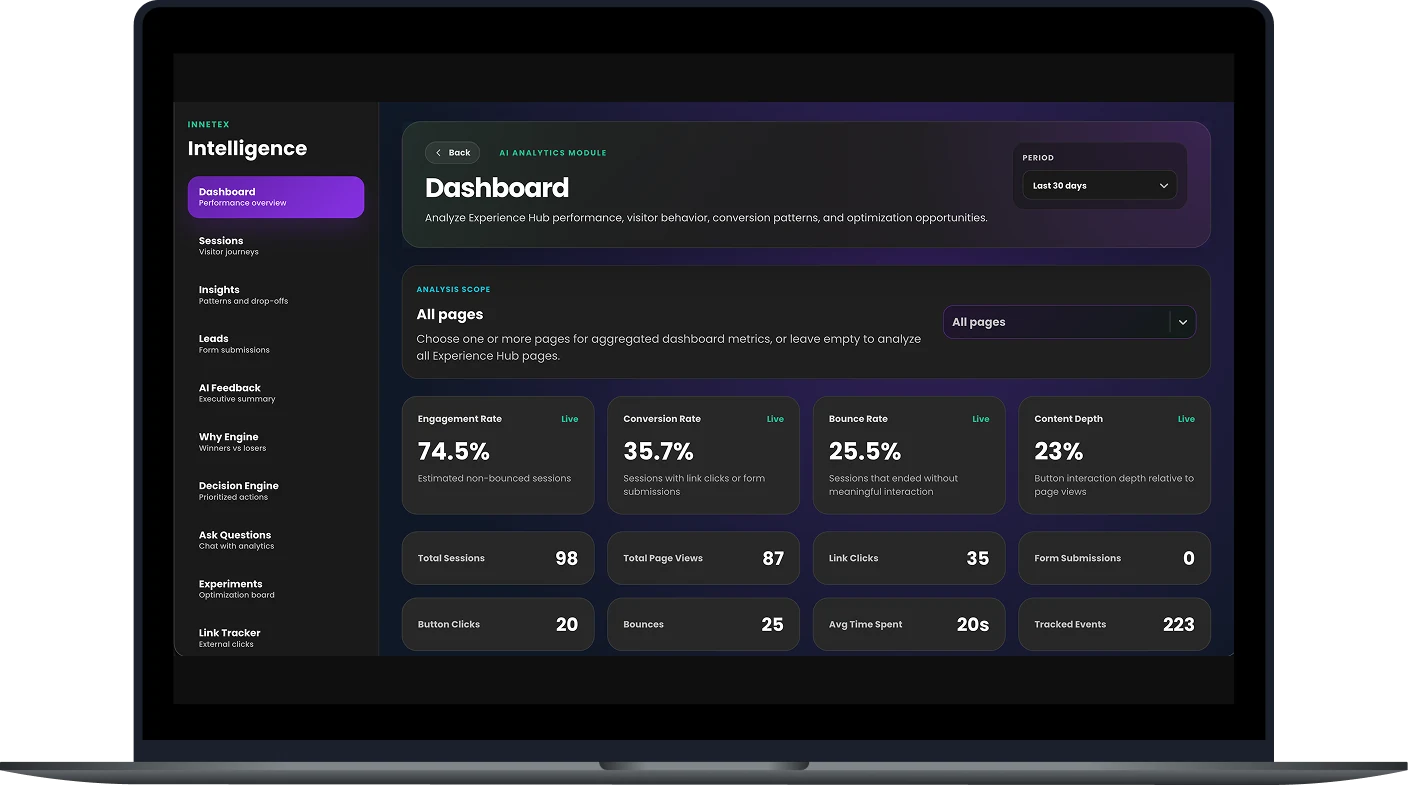
The Innetex intelligence dashboard

What Innetex is

A business card every employee carries, and the company still controls

An employee taps their phone against someone else’s and the card transfers. What that card is allowed to say is not up to them, it is a company decision, and it is made in one place.

Company policy

Set once, for everyone. Try one.

Thirty-one switches like these in the real panel, set for the whole company or overridden for one person.

Every card in the company

2 of 3 fields shared

  • Sales
    Sales card. Sharing: Direct phone number, Social and payment links.
  • Support
    Support card. Sharing: Direct phone number, Social and payment links.
  • Field
    Field card. Sharing: Direct phone number, Social and payment links.
  • Ops
    Ops card. Sharing: Direct phone number, Social and payment links.
  • Partners
    Partners card. Sharing: Direct phone number, Social and payment links.
  • Exec
    Exec card. Sharing: Direct phone number, Social and payment links.

One change, and it lands on every phone in the company before anyone hands out another card.

A company hands every employee a digital business card. Not a PDF and not a line in an email signature, but a card that lives on the phone and transfers by tapping it against someone else's, or by scanning a code when tapping is not an option.

Everything behind that tap is the product. Admins run the company from a panel: who has a card, what each card is allowed to show, which fields are locked, what the team is working towards, and every lead that came back. A page builder lets them publish landing pages without a developer, and an analytics engine explains what visitors did once they arrived.

It is sold as software, so the platform also has to sell itself. Subscription tiers, seat counts that change mid-month, upgrades that take effect immediately, and billing that stays correct while all of that moves.

One tap, end to end

From a handshake to a lead the company can act on

NFCSave contactSendNew lead

01One phone taps another, and the card transfers

Two halves of one system

One is in a pocket at a conference, the other is open on a desk all day. They share a database, a permission model and a release cadence, and we build both.

The app people carry

Built for the moment two people meet

Flutter on iOS and Android, with the physical layer that makes a card worth carrying: near-field for tapping phone to phone, Bluetooth and nearby discovery for handing a card to a room, a scannable code when neither is available, and a home screen widget so sharing takes one press and no searching. Contacts save straight to the device, files and PDFs travel with the card, and the whole thing keeps working when the signal does not.

The panel the company runs

Everything an administrator needs, in one place

React, fourteen screens and three roles, sitting on twenty-nine cloud functions. Admins add people, approve the ones who sign themselves up, decide what every card may show, set targets, read the leads and export the numbers. The same panel carries the page builder and the analytics module, so the company never leaves it to do the next thing.

Our part

What we built

Design, apps, panel and backend. There is no part of this platform that came from somewhere else.

The page builder

Landing pages without waiting for a developer

A drag and drop canvas with thirteen component types, from headings and forms to video, accordions and booking embeds, plus company fonts, icons and colour sets. Pages are drafted, commented on, published and unpublished by the client themselves, and a separate renderer serves them publicly with responsive rules generated from the same component tree.

The intelligence module

Analytics that answer why, not just how many

Ten screens covering sessions, engagement signals, drop-off, page comparison and link tracking, built on first-party event data rather than a third-party tag. Four of them call a language model server side: a performance summary, a why engine that compares sessions that converted against sessions that did not, a decision engine that ranks what to change, and a question box over the whole dataset.

The billing engine

Money is the part that cannot be wrong

Three subscription tiers, seat counts that change mid-month, and upgrades that take effect immediately. Every change is priced by Stripe as a preview the customer confirms, applied with the same proration timestamp, and reconciled through signed webhooks written into the database as the source of truth. Nothing about what a customer owes is calculated in a browser.

The long run

Still ours to build, and still ours to fix

Innetex has never been handed over to another team. Eight of our people have worked on it, releases go out on the rhythm they did in the first year, and a change asked for this week does not begin with somebody opening the codebase for the first time.

0+
releases shipped
0
major versions
0
people from our team on it

The whole thing

Six parts, one system, all of it ours

Open any layer to see what is inside it. Every count comes from the code we still maintain.

  • What an employee carries, and the only part of the system a stranger ever touches.

    • iOS, Android, macOS and web from one Flutter codebase
    • Near-field tap, Bluetooth, nearby discovery and scannable codes
    • Home screen widget, contact saving and files that travel with the card
    • 28,000 lines, twelve major versions
  • Where a company runs every card it has issued, and everything that came back.

    • Fourteen screens across three roles
    • Thirty-one permission switches, set per company and per person
    • Employee approval, goals, leads and exports
    • Seven charts and seven tables over live company data
  • So a company can publish a landing page without waiting for a developer.

    • Thirteen component types on a drag and drop canvas
    • Drafts, comments, publish and unpublish, all client side of the relationship
    • Company fonts, icons, images and colour sets
    • A separate public renderer with generated responsive rules
  • First-party analytics that try to explain behaviour rather than count it.

    • Ten screens: sessions, insights, drop-off, comparisons, link tracking
    • Events collected first-party, not through a third-party tag
    • Four capabilities call a language model server side
    • An experiment board that turns a recommendation into a test
  • The part that cannot be wrong, because it decides what a customer is charged.

    • Three tiers, plus seat counts that change mid-month
    • Every change previewed by the payment provider before it is applied
    • Signed webhooks written to the database as the source of truth
    • Duplicate and out-of-order events rejected in a transaction
  • The layer everything else stands on, and the one nobody sees.

    • Twenty-nine cloud functions in production
    • Twenty-five data models kept in step with each other
    • Authentication, storage, mail and code redirects
    • One database serving apps, panel and public pages at once

If you are building something this size

Looking for a team that will still be here in year five?

Tell us what you are building and where it is straining. The conversation costs nothing, and you will talk to the people who built everything on this page, not a sales team.

For product companies

If your platform has to keep growing while people are using it, that is the work we have been doing for one client for five years. Apps, panel and backend from one team, with releases that land without drama.

For an MVP that outgrew itself

The awkward stage is when the thing you built to prove an idea has to become the thing you sell. We have taken that exact route once already, from a single app to a platform with a builder, analytics and a subscription business behind it.

Two ways to start

Talk it through

Fifteen minutes on your product and where it is heading, and our first read on it.

Book the call

Start in writing

Describe it below and we will reply with our first thoughts.

Where are you right now?